Vatican City: Visiting the World's Smallest Country
What is the world’s smallest country? It’s one of those trivia questions that comes up all the time. While you might think about Tuvalu or Nauru in the South Pacific, or the two square kilometre Monaco on the French Riviera, the answer is Vatican City.
Entirely landlocked inside Italy, and completely surrounded by Rome, around 800 residents fill just 0.49 square kilometres of the micronation. That means it’s the smallest country by both size and population.
Ruled by the Pope, and governed by the See of Rome (aka the Holy See), the Vatican was actually under Italian rule until 1929. It was then that the Lateran Treaty established the independent state of Vatican City and legislated the special status of Catholicism in Italy. It has its own post office and stamps. There’s shops just for the residents. It has an Italian embassy and vice versa.
We recently visited Vatican City while on a trip around Italy, drawn not only to its history but its impressive architecture and sublime art collections.
And just like that, we stepped into the world’s smallest country.
Arriving in the Vatican
We stepped right into Vatican City. Unlike many countries, there are no passport controls, visas or border checks. In fact, 27,000 people visit there every day — and you really feel it at times.
Because we had sailed into Civitavecchia, and were on a small group tour of Rome, we entered with a guide and fellow passengers. (If you are cruising, the Italian port of Civitavecchia is the closest one to Rome, but that is almost an hour away by road depending on traffic.)
The first thing we noticed was just how ordinary all that felt. After all, this was a day where we’d seen the Roman Forum and the Colosseum in person for the first time. Yet we were in another country. The other one still in sight. And then you turn around and pop up in St. Peter’s Square, a site where so many historic moments have happened.
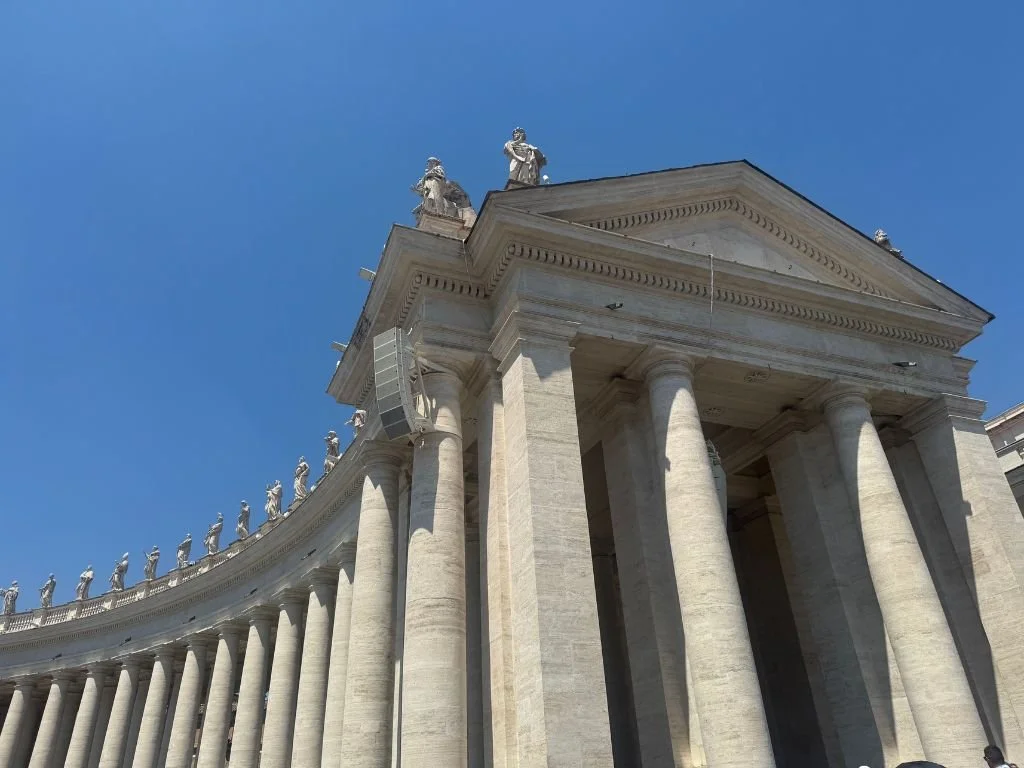
St Peter's Square
Walking into Piazza San Pietro (or St. Peter’s Square) is a humbling experience. The architecture alone is all-encompassing. The Doric columns of Bernini’s Colonnade wrap around us in both directions. The statues of 140 Saints line the columns. Standing in the right place, an optical illusion makes it look like the columns of four form a single line.
It’s hard to miss the Obelisk that stands firmly in the centre of the square. Originally brought to Rome from Egypt by Emperor Caligula in 37 AD, it was moved to its current site in 1586. It’s the only obelisk in Rome that still stands since antiquity.
But it’s the unmistakable shape of St Peter’s Basilica that dominates the visual landscape. It’s distinctive domed cupola forms the backdrop to the Papal Station, where we’ve seen so many broadcasts of the Pope delivering an address or mass. It’s visible almost wherever you go: from the Square, the courtyard of the Museums, and in many spots around Rome.
St Peter's Basilica itself was closed to the public on the day we visited. It was a Wednesday, and is traditionally closed in the mornings for the Papal Audience, but it was still closed for an occasion on this particular day. You’ll often find this apparently, and the Sistine Chapel can also close at the drop of a hat. It is, after all, still a working religious order.
The Vatican Museums
I have to admit: I had no sense of what was in the Vatican Museums before visiting. Little did I know this was the heart of the Vatican’s most beautiful treasures.
As we approached the MVSEI VATICANI, lines stretch around the block, all the way around the walls that define the 44 hectares of the Vatican. Our guide speaks in some secret code with the guards and the lines part for us like the Red Sea. It’s who you know, I guess.
From the moment we step inside the Museum, it’s an endless series of eyes-up, jaws down moments. I’m still processing much of it months later. The long gilded corridors. The ancient statues. The sharply contemporary Pomodoro Sphere Within Sphere. The impossibly awesome frescos of the Gallery of Maps.
We could spend days in here, but we’re rushed through the throngs of people by our Vatican-specific guide and onto the artistic crown jewel of the Vatican: the Sistine Chapel.
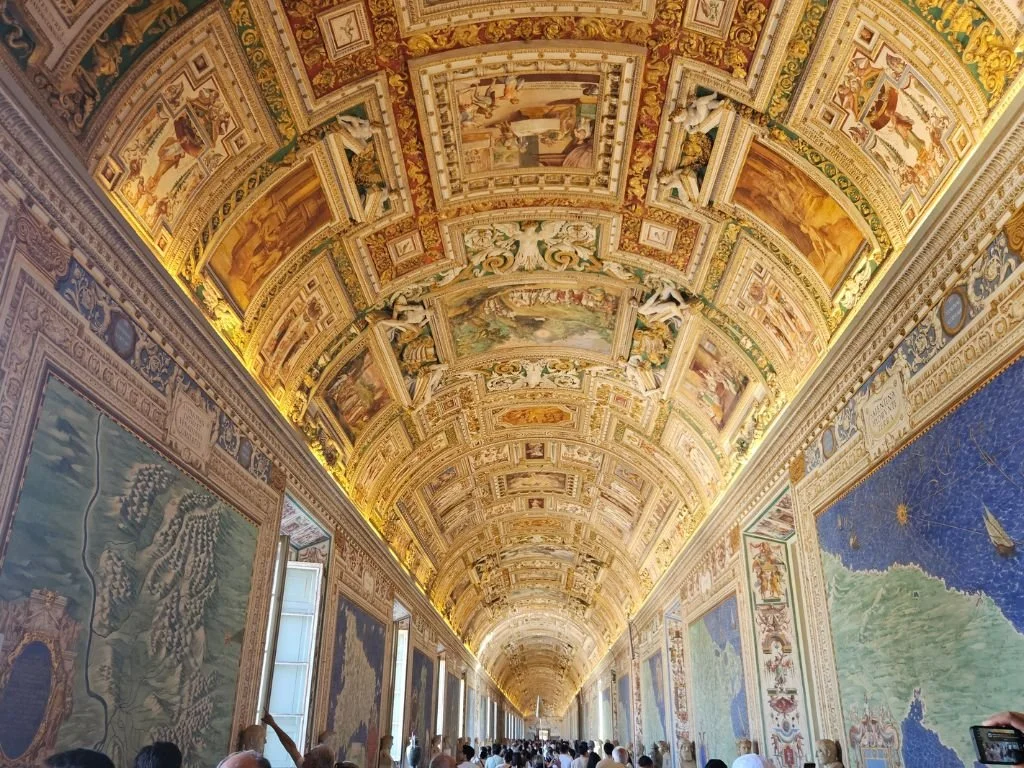
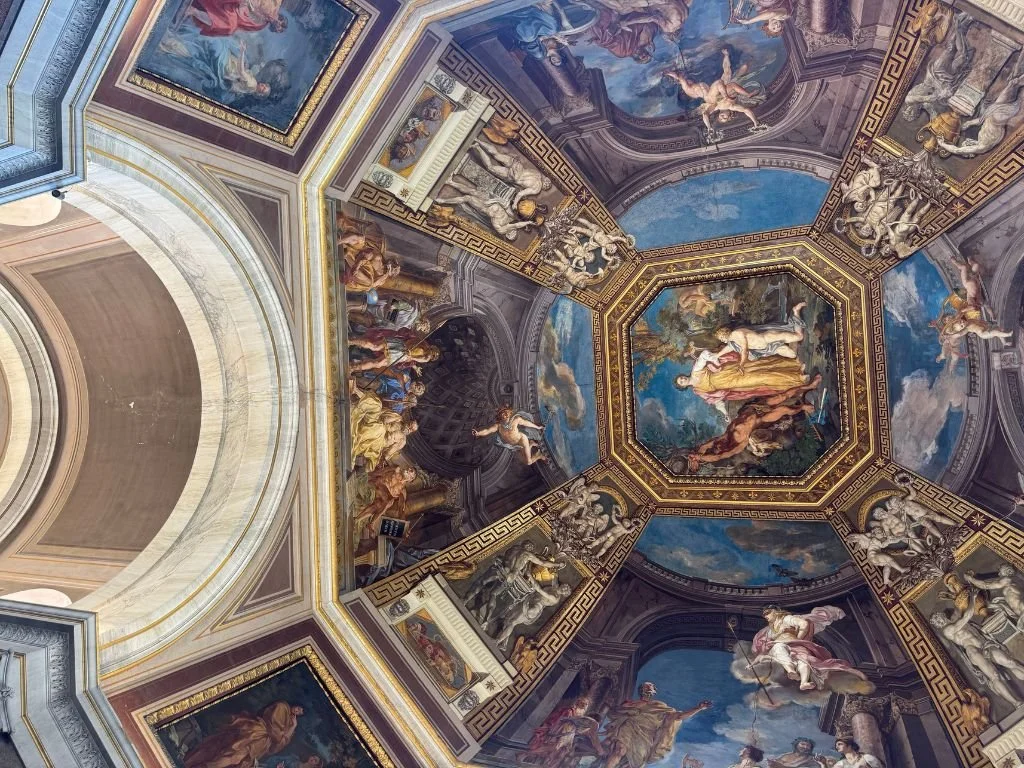
The Sistine Chapel
It’s hard to put into words the feeling of stepping into one of the world’s most iconic venues, or seeing it’s famous artworks. Originally built in 1473, it’s best known for it’s papal conclaves and the Renaissance frescos by Michelangelo, including what is possibly the most well-known ceiling in the world.
That rush slows down and time stands still as we enter the Sistine Chapel in hushed tones. What I wasn’t prepared for was just how much art there is inside. Painted between 1508 and 1512, it covers the walls on all sides and, of course, the ceiling.
With no photos allowed, all eyes are turned up on The Creation of Adam, his yet lifeless hand about to receive the spark of creation from his maker. It is but one detail of thousands in the room. Scenes, moments, stories we all know from their countless depictions. In The Last Judgment, Michelangelo’s signature, his empty and hanging skin, is just one of these details.
Surrounded by hundreds of our closest new friends, we’re all shuffled out of a door and back to a kind of reality.
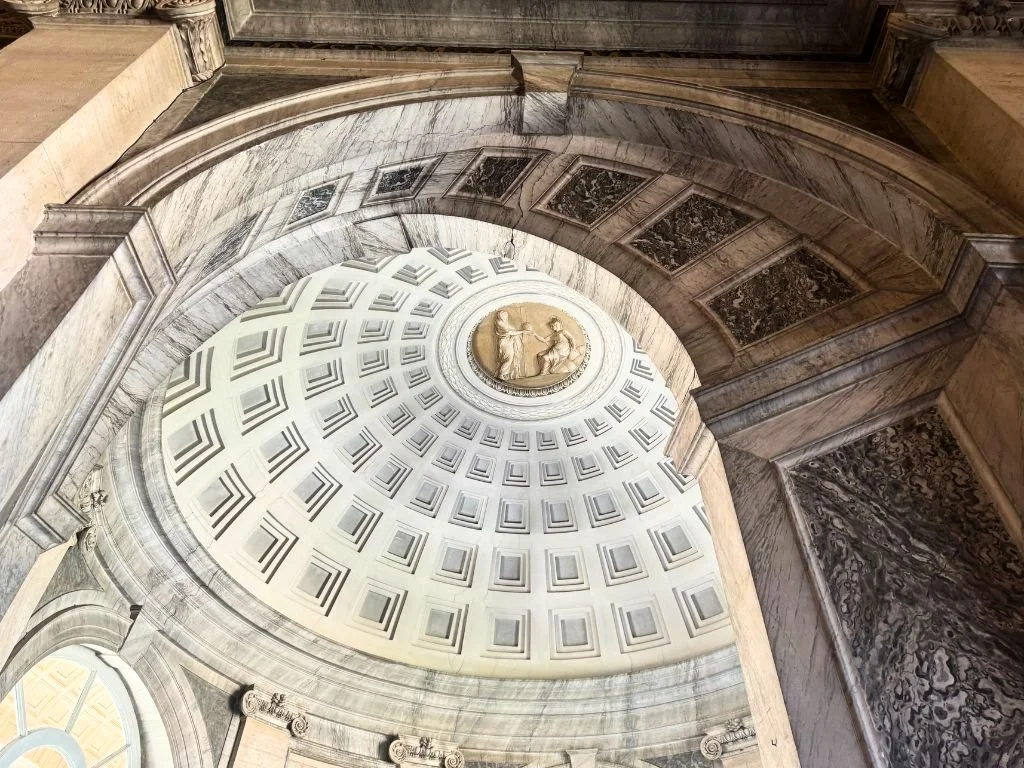
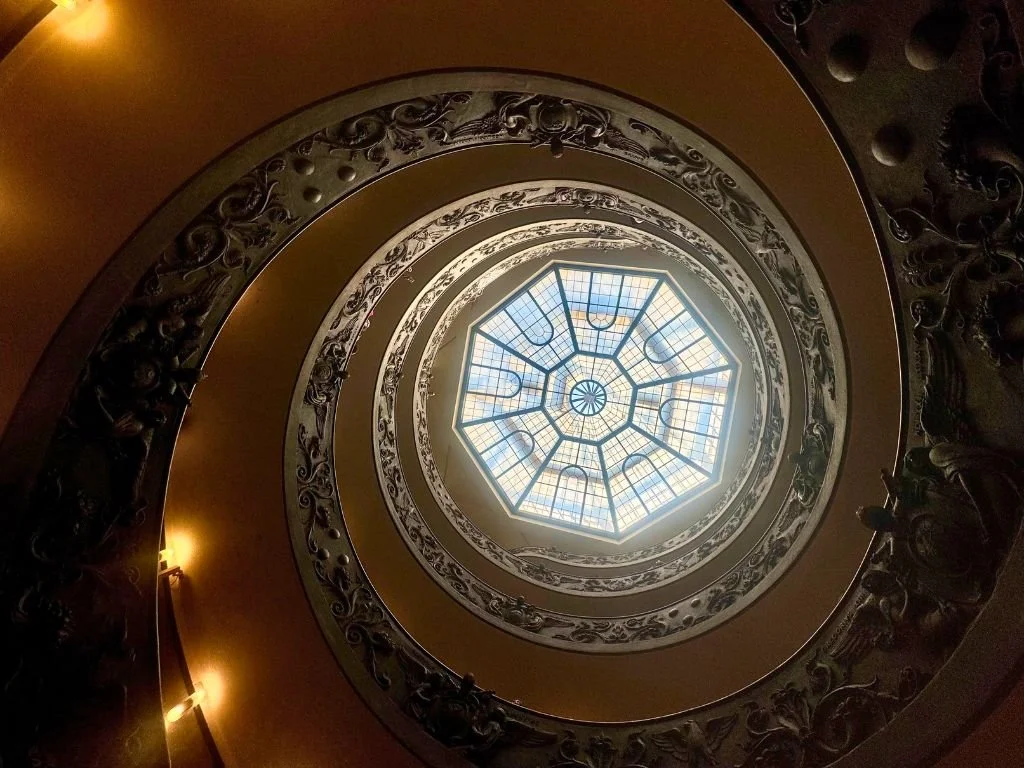
The curve of the steps as you exit the Vatican Museums.
Practical Tips for Visiting
Book a tour — Yes, you can walk straight in. But if you’re with a good tour, you often get to skip the massive lines. Look for tours that specifically mention this. It’s more expensive, but you get more time there. Our tour had separate guides for Rome and the Vatican, and a third assistant guide, which made a huge difference
Dress code — In the Sistine Chapel, and some other places of worship, people of all genders are asked to wear clothes that cover their shoulders and knees, even in summer. Hats are also “not allowed” officially.
There are a lot of people — When we said that 27,000 people visit daily, that’s no exaggeration. At times it will be overwhelming. You may not get to spend time lingering over art. Or set up a full-on selfie spot.
It’s a workplace — You are visiting. There’s heaps of icons. But there’s also daily activities going on, people working and things may be closed on short notice. As Fran Lebowitz said, ‘pretend it’s a city.’
Bring a passport — Even though there’s no formal check at the walls, you are still crossing a border. Our passports were also apparently required for the purchase of Vatican Museums tickets.
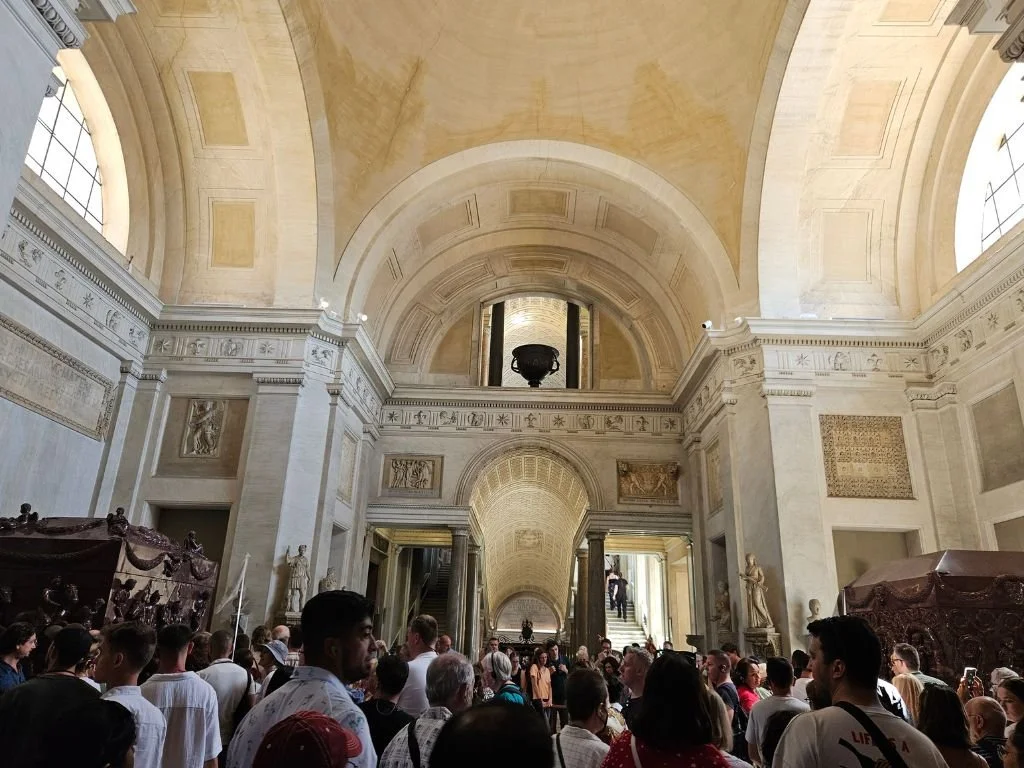
The reality of the crowds at the Vatican Museums.
Final Thoughts
On the way out, circling down the spiral staircase leading out of the museums, we struck up a conversation with a priest from Louisiana. He seems a little less dazed by than us. Even so, I got the impression that even someone more familiar with the local practices was still a little lost for words by it all.
If we did this again, we’d probably want to spend a little more time. We packaged this with a Rome day tour, and while I don’t necessarily feel like I missed out on anything, some parts were necessarily rushed. The Vatican Museums alone could take three or four hours. If you are really keen to spend time — with the art or the Bascilica in particular — I’d either find a dedicated Vatican tour or commit to a full day there.