How do you build a practical travel wardrobe that works across multiple climates, without having to pack single-purpose clothing for each destination? It's not easy, but with a bit of planning, it is possible.
Earlier this year, we set off on a multi-month trip that took us from Iceland to Barcelona, with a lot of places and climates in between. We experienced everything from chilly Nordic days to the considerably warmer weather of the Mediterranean, all while living out of one modest suitcase each.
There is plenty of advice about packing light, capsule wardrobes and minimalist travel out there. Some of it is useful, but after several months on the road, I found that a few relatively straightforward strategies made the biggest difference.
I don’t quite subscribe to the the Rick Steves ‘pack for one week with carry on only’ philosophy just yet. But I have started to embrace a similar idea of the three L’s; relying on layers, doing laundry, and having a strict packing list. I’ve written about the importance of a packing list here and never leave home without one. But let’s see how the other two can set you up for travelling through multiple climates.
A note about the photos: All the images in this article were taken during the same trip in 2026. I've chosen them to illustrate the range of climates and conditions we experienced along the way, from the Mediterranean to Iceland.

A sunny morning looking at the Sagrada Familia in Barcelona
Repeat after me: your travel wardrobe is different than your day to day wardrobe
This is one of the lessons I took away from our big trip. A travel wardrobe has a very different job to do.
At home, most of us have the luxury of choosing from a fairly extensive collection of clothes. We have different things for different seasons, occasions and activities. When you're travelling for months, that's simply not practical. You need clothes that work harder, take up less space, can adapt to changing conditions and are easy to care for.
When you're travelling for months, you need a relatively small collection of clothes that work together, can be worn repeatedly and adapt to different conditions. You probably don't need the same variety of clothing you have at home.
Nobody is keeping track of how often you wear something and, when you're travelling, comfort and practicality become far more important than having lots of options. Do you really want to be dragging 50 kilos of clothing across the cobblestones just to have one more pair of shoes? Really?
Pack for what your clothes can do for you, not how many different outfits they can make. Here are some big and small shifts to help move your thinking from your everyday wardrobe to one that's fit for travel.
Layers are your best friend
Rather than packing a bulky outfit for every temperature, think about clothing that can be added or removed.
My layering recipe tends to be:
A lightweight base layer like a knit or T-shirt
A mid-layer such as a cardigan, jumper or button down shirt
A lightweight puffer for warmth, an outer shell that protects against wind and rain, or if things get really nasty, a combination of a puffer AND an outer shell.
You don't necessarily need all of those layers every day, of course. That's the point. You can add and remove them as the weather changes. This is particularly useful when you're travelling through several climates.
And don't underestimate the little things. People can spend a lot of time thinking about jackets and trousers but overlook the accessories that make a cold day considerably more comfortable, or protect you from the sun. A lightweight beanie and thin gloves take up very little room but can make a surprisingly big difference. Technical fabrics are worth considering here. You don't necessarily need thick woollen accessories when lightweight synthetic or merino alternatives can do the job.
A scarf can pull double duty too. I have a plain-coloured wrap made from an SPF 50 fabric that has saved my skin, literally, more than once in summer. But I can also use it as a scarf when the weather is colder too, just double or triple the wrapping and keep the warmth in.

An overcast day and a gravel pathway in Thingvellir National Park in Iceland
Embrace merino wool
Merino wool is kind of a magical thing. You can wear it in warm weather, you can wear it in cold weather, it doesn't need to be washed as often as many other fabrics, and it's thin and lightweight. It's also naturally antimicrobial, which is particularly useful when you're travelling and don't have access to a washing machine five minutes away. And it somehow dries in half an hour when you do wash it.
Like is this some sort of alien technology?
There is some clever science behind it. Merino fibres can absorb a significant amount of moisture vapour without feeling wet or clammy, while the natural structure of the fibres helps regulate temperature. In cold weather, they trap air close to your body, helping keep you warm. In warmer weather, they help move moisture away from your skin and release it into the air. Even better, merino can continue to provide insulation when it gets damp.
One qualification: merino isn't indestructible, and lightweight merino can be expensive. You don't need an entire wardrobe made from it. A few carefully chosen pieces, particularly T-shirts, socks or a base layers, can make a big difference.
Do laundry, even when it's inconvenient
This is one of the biggest differences between packing for a holiday and packing for a longer trip. You don't need enough clothes for the entire trip. You need enough clothes to get you between laundry opportunities.
We plan to do laundry about once a week on shorter trips and, on longer trips, try to stretch it closer to every two weeks by washing smaller items along the way. When booking accommodation for longer stays, we often look for somewhere with a washing machine. If we're on a cruise, we check out the laundry options before we leave. Quick-drying fabrics, particularly merino wool and technical fabrics, are useful here.
Expert tip
Don't forget about drying time. especially in colder or more humid destinations. That shirt you washed in the evening might not be ready for the next morning! We take big zip lock bages or wet/dry bags for these times.
Don't underestimate your footwear decisions
Shoes are one of the hardest things to pack for changing climates because, unfortunately, they haven't yet invented compression packing cubes for footwear. Shoes take up a lot of space, add weight and are much harder to adapt to changing weather than clothing. You can add a layer when it gets cold. You can't make sandals behave like winter boots.
For a long trip, we try to keep the number of pairs down and choose shoes that can do more than one job. A comfortable walking shoe that can cope with rain is much more useful than a dedicated sightseeing shoe, a separate casual shoe and something you'll only wear twice.
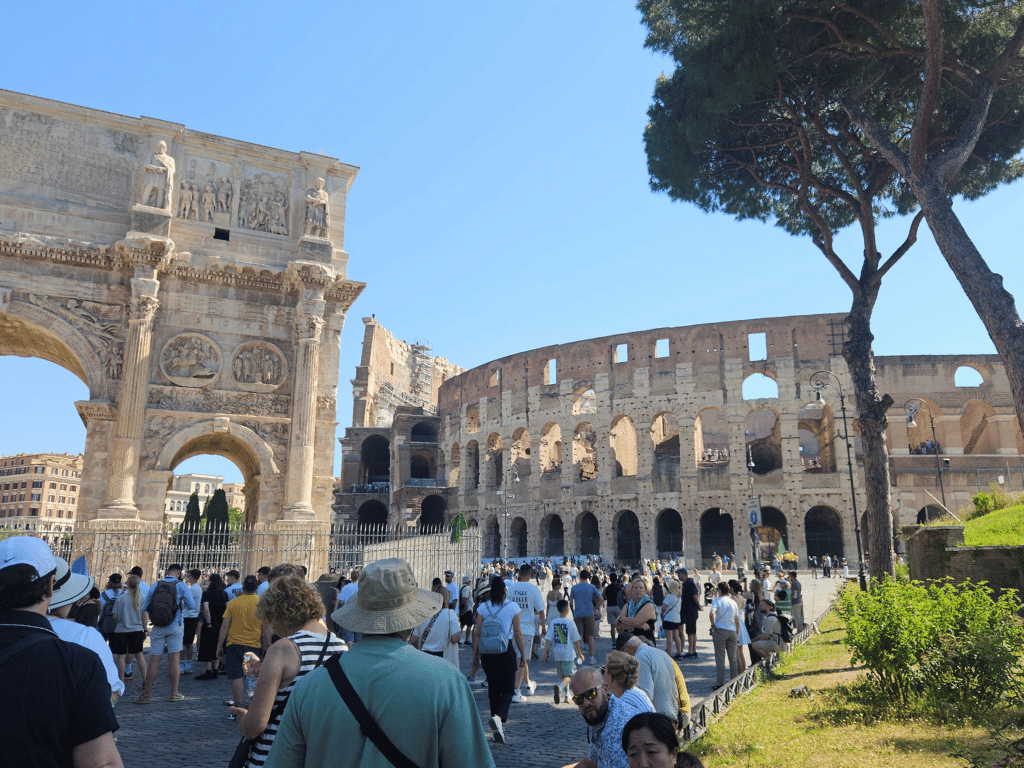
A particularly steamy day at the Colosseum in Rome
But give yourself permission to buy things if you need to
You arrive in Tokyo in September and it's way hotter than you expected? Yup, been there. Arrive in Copenhagen when a cold snap hits? Yup, us too. Give yourself permission to buy something rather than suffering.
One of the traps of packing for a long trip is trying to anticipate every possible weather scenario before you leave home. You can't. Weather has a nasty habit of ignoring your carefully researched packing list. If you need another layer, a pair of shorts or a warmer hat, you can buy one. And if you're lucky, it becomes a useful souvenir from the trip.
Expert tip
Remember is that retail cycles are usually a season ahead. Looking for summer clothing in late September can be surprisingly difficult, particularly in places that are already moving into autumn stock. Check ot local thrift stores or charity shops for current stock and probably cheaper prices.
Compression packing cubes are a lifesaver
Compression packing cubes are everywhere, I know. But when you're travelling between climates, finding ways to reduce the volume occupied by bulkier clothing can be a lifesaver.
We really like the Thule compression cubes. We used them on our longer trip and the zips were really strong and the fabric held up well. After months of being opened, closed, shoved into suitcases and moved between hotels and cruise cabins, they were still going strong.
They also help with organisation. We use different cubes for different categories of clothing, which almost creates drawers when we're unpacked in a hotel room or cruise cabin. It also makes moving between hotels much easier because we can pull out what we need without completely unpacking everything.
One small caveat: compression cubes reduce volume, not weight. You can still end up with a very heavy suitcase if you use them as an excuse to pack more. In fact, there is a dangerous moment when you realise that you have compressed your clothes so efficiently that you now have room for more clothes. Resist the temptation.

A chilly day exploring Tallin, Estonia
Don’t think of it as a wardrobe, think of it as a toolkit
Finally, remember that the goal of packing for changing climates isn't to have the perfect outfit for every possible temperature, it is to have enough comfortable, versatile clothing to deal with whatever the trip throws at you. Some days you might be wearing several layers. A few days later, you're in shorts and a T-shirt. Your merino socks are doing the heavy lifting in Iceland, while your SPF wrap is earning its keep in Spain. Somewhere along the way you may buy a jumper because the weather did something unexpected.
That's travel.
You don't need to recreate your entire wardrobe in a suitcase. You need a small collection of clothes that can work together, adapt to changing conditions and get you through to the next laundry day. And, ideally, leave enough room in the suitcase for the things you inevitably find along the way.