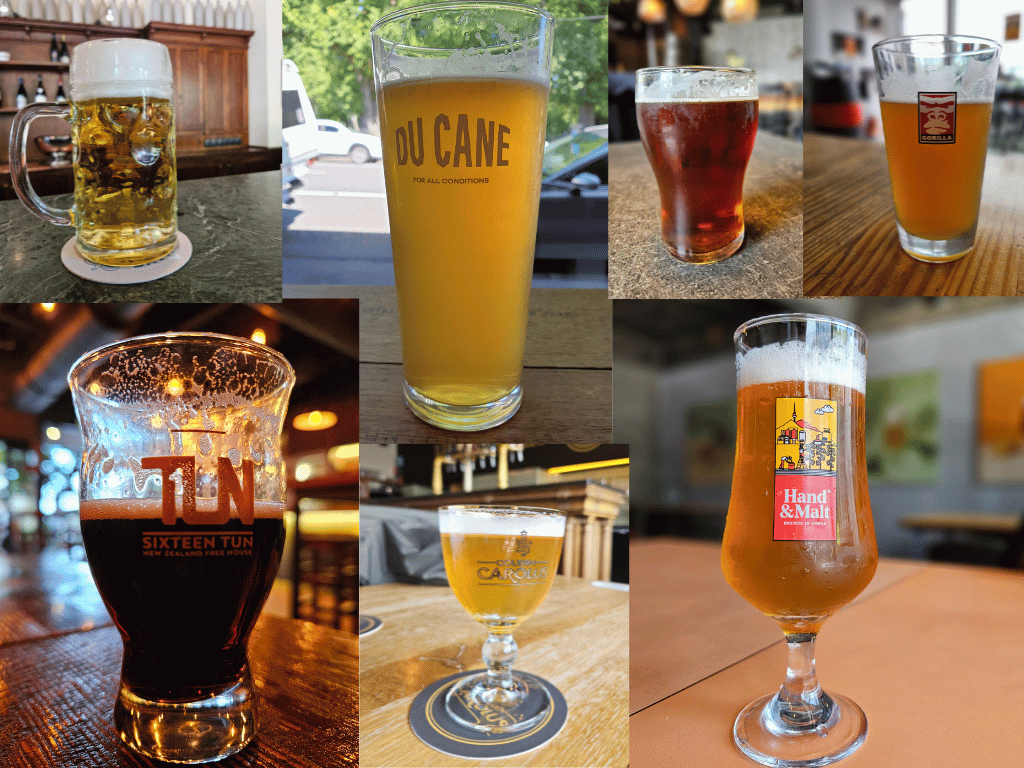
Pints, tulips, steins, goblets, mugs. There are almost as many types of beer-drinking vessels as there are types of beer. But how much do you know about the history, science and traditions behind the vessels we drink it from?
Ready to find out? Challenge yourself with sixteen questions about the wonderful variety of glassware (and other things) we drink beer from.
1. Bob Hawke famously claimed a place in drinking history while studying at Oxford. What did he reportedly drink in 11 seconds?
Reveal Answer
A. A yard of ale. Hawke reportedly drank approximately 1.4 litres of beer in 11 seconds in 1954. The story became part of his public persona, although the historical record has subsequently been questioned. The yard-long vessel itself is a distinctive drinking glass, traditionally with a bulbous base and a long, narrow body.
2. You've finished half a beer, and a pattern of foam clings to the inside of your glass. What is this phenomenon called?
Reveal Answer
A. Belgian lace. Also called beer lacing, these patterns form when beer foam clings to the inside of a glass. A clean glass helps foam form and persist, while grease and detergent residue can interfere. The beer's composition and the way it's poured also affect the result.
3. Despite both being called a 'pint', a British imperial pint and a pint in New York do not contain the same amount of beer. Which one contains more beer?
Reveal Answer
The British imperial pint is larger. It contains approximately 568 ml, compared with around 473 ml in a US liquid pint. That's about 95 ml more beer in the British pint.
4. In 2008, Anita Schwarz of Germany set a Guinness World Record over a distance of 40 metres (131 ft). What did she carry?
Reveal Answer
Anita Schwarz carried 19 full beer steins over 40 metres, setting a record for the most beer steins carried over that distance by a woman. The record was achieved in Mesenich, Germany, on 9 November 2008.
5. A tulip-shaped beer glass narrows towards the middle before flaring out at the rim. What's the main reason for this design?
Reveal Answer
A. To concentrate aromas while accommodating the foam. The bowl helps collect and direct aromas towards the nose, while the flared rim provides room for the beer's foamy head.
6. As of 2026, which of these celebrities has NOT been documented doing a shoey, the Australian tradition of drinking beer or champagne from a shoe?
Reveal Answer
B. Chappell Roan. At the Gold Coast Laneway Festival in February 2026, Roan reportedly declined to do a shoey when the crowd called for one. Harry Styles did a shoey at a Perth show in 2023, while Hilary Duff reportedly joined in at a Melbourne show in 2026. Although drinking alcohol from a shoe isn't uniquely Australian, the shoey has become a recognisable celebration at Australian sporting events and live shows.
7. The traditional British dimpled beer mug has a chunky handle and a surface covered in concave circles, or dimples. What was the practical appeal of this style?
Reveal Answer
B. It provided a sturdy, substantial drinking vessel. The dimpled mug became a familiar sight in British pubs after the Second World War. Ravenhead Glass's P404 design is particularly associated with this style.
8. Where does the ubiquitous American 'shaker' pint glass get its name?
Reveal Answer
B. The shaker pint takes its name from its use with a cocktail shaker. Its versatility and relatively simple design helped it become a common beer glass in American bars.
9. The word pint came into English through French and is thought to have Latin roots. What does its proposed Latin origin mean?
Reveal Answer
A. A painted or marked measurement. The word pint came from Old French pinte, which is thought to derive from the Medieval Latin pincta, related to the Latin word picta, meaning 'painted'. One theory is that this referred to a mark painted on a vessel to indicate its capacity. The precise origin of the word is uncertain, however.
10. Fill in the blank: The tiny etched mark at the bottom of some beer glasses that encourages a stream of bubbles is called a ______ point.
Reveal Answer
A nucleation point, also called a nucleation site. The etched area provides a place for dissolved carbon dioxide to form bubbles, giving the beer a lively, sparkling appearance.
11. The red Solo cup is a mainstay of American college party and backyard drinking culture. True or false: the ridges in the cup indicate standard servings of beer, wine and spirits.
Reveal Answer
False. The popular claim that the ridges were specifically designed to measure standard alcoholic servings is a persistent myth. They are there to improve the structure of the cup and make it easier to hold when the surface is covered in condensation.
12. The Spiegelau IPA glass was designed to showcase the aromas and flavours of India pale ales. Name either of the two American breweries that collaborated on its development. (Hint: one is based in Delaware and the other in California.)
Reveal Answer
Dogfish Head and Sierra Nevada. The glass was developed to showcase IPA aromas and flavours, with a ridged lower section designed to agitate the beer as it moves through the glass.
13. What is the distinctive feature of the British Nonic pint glass?
Reveal Answer
An outward bulge near the top of the glass. The outward bulge helps prevent rims from chipping when glasses knock together or are stacked. It also provides a convenient place to grip the glass.
14. In 1978, Oktoberfest introduced its first official annual commemorative beer stein. What problem were these collectible mugs originally intended to solve?
Reveal Answer
A. People were taking the festival's ordinary beer mugs home as souvenirs! The Oktoberfest Jahreskrug was introduced as a dedicated keepsake, giving visitors something to take home rather than helping themselves to the beer tents' regular Maßkrüge. Made by Rastal in the traditional Keferloher clay-mug style, the annual commemorative steins have since become collector's items.
15. True or false: Food & Wine magazine recommends avoiding beer glasses that have been chilled in the refrigerator or freezer.
Reveal Answer
True, according to the cited Food & Wine article. Its explanation includes the potential effects of very cold glassware on aromas and flavours, the risk of odours or residue in freezers, and the possibility of fragile glass cracking under sudden temperature changes. Food & Wine
16. A 2012 study at the University of Bristol found that the shape of a beer glass could influence how quickly people drank. Participants were given 12 fl oz of lager. Which type of glass did they take longer to finish their beer from: a straight-sided glass or a curved glass?
Reveal Answer
The straight-sided glass. Participants took nearly 12 minutes to finish their beer from a straight-sided glass, compared with just 7 minutes from a curved glass. Researchers suggested that curved glasses make it harder to judge the halfway point, potentially making it more difficult for drinkers to pace themselves. Read the study.
How did you go? Did you learn something new?
If you like trivia and learning new things, try a few more of our trivia games.