48 Hours in Reykjavik: A First-Timer’s Itinerary with the Golden Circle
Is 48 hours enough in Iceland? You can tick off all the major sites, and get a taste for more, without breaking the budget.
Gullfoss (or Golden Falls) on the Golden Circle trail. Yes: that photo is real.
The flight from Toronto to Reykjavik is often treated as a convenient stopover en route to Helsinki, Oslo or elsewhere in Europe. But ‘convenient’ is about the only normal thing about Iceland.
It’s just five hours from eastern North America, and the journey quickly dissolves into a foggy morning as an otherworldly landscape emerges beyond the airport. We’ve also just missed our bus.
The cab driver points out where the old lava stops and the new begins. There’s sulphur in the air, steam rising from the earth itself. This is how our two days in Iceland begin: a place where a weekend break comes with tectonic plates and the thunder of waterfalls. Somewhere in the back of our minds, Led Zeppelin is already on cue.
Arrival: Landing in Iceland
We’ll be honest: this was the only sour note of the entire weekend.
We landed just after 6:00am on a Monday and were met with a sea of people at immigration…and row upon row of red lights on the automated gates. The queue doubled back on itself, with staff redirecting passengers just as we seemed to inch forward, while long conversations played out at the handful of staffed counters. We’re told it “isn’t normally like this”, but it still took over two hours.
By the time we emerged into the arrivals hall at Keflavík International Airport, it wasn’t immediately obvious where to go. We found the bus departures just in time to confirm that ours—booked for an hour earlier—had long since left. The next wasn’t for a while.
Pro Tip
Buses do not wait, even if you have a booking. Cabs are incredibly expensive, costing between 9,000 and 15,000 ISK ($65–$110 USD) for a ~20-minute ride on average.
Stop one: The Blue Lagoon
After a 20-minute drive, the cab dropped us at a black box in the middle of a former lava field. This, it turns out, is luggage storage. The catch: the lagoon itself is still a 10-minute walk away. So, bundled in winter coats and clutching bathers, we set off down the foreboding path.
Pro Tip
Make sure you have everything you’ll need for your spa day before leaving your bags—the storage building is completely separate and part of the parking lot.
Check-in is a little opaque for first-timers. You’re issued a colour-coded wristband tied to your package, which doubles as your locker key and payment method for drinks, masks and anything else you decide you suddenly need while floating in geothermal bliss.
With basic entry, we were funnelled into separate gendered changing rooms. The process isn’t especially well signposted: stash your gear, take the mandatory shower, then head through the internal doors to the lagoon. Simple…once you know it.
Then you step outside, and none of that matters.
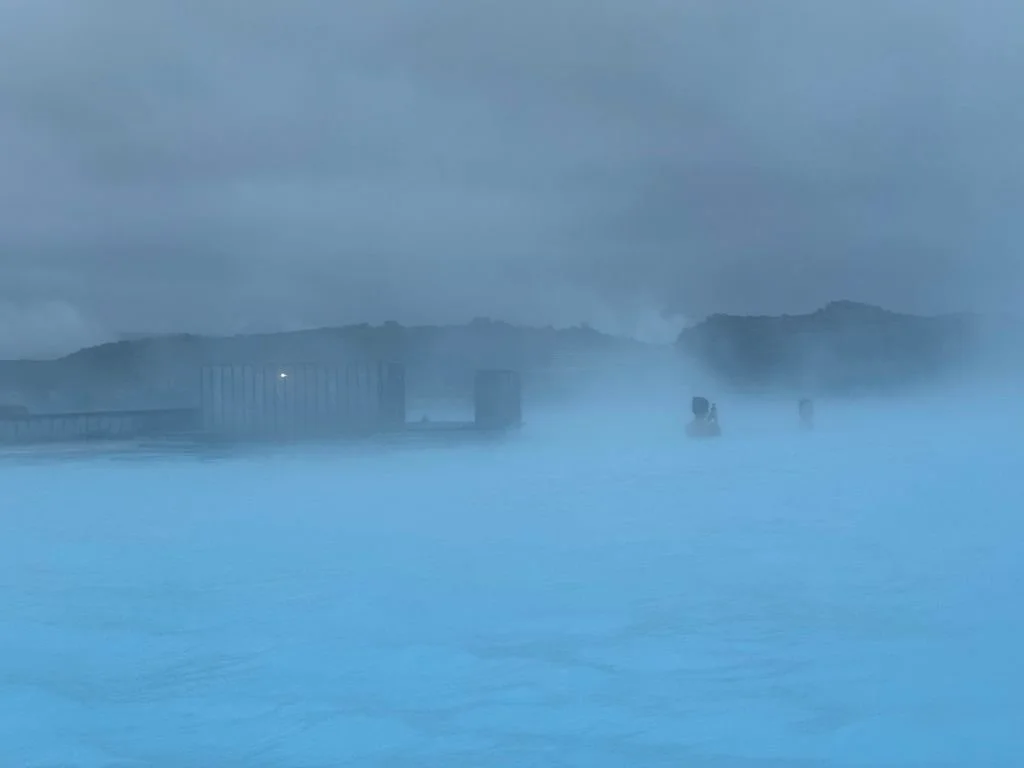
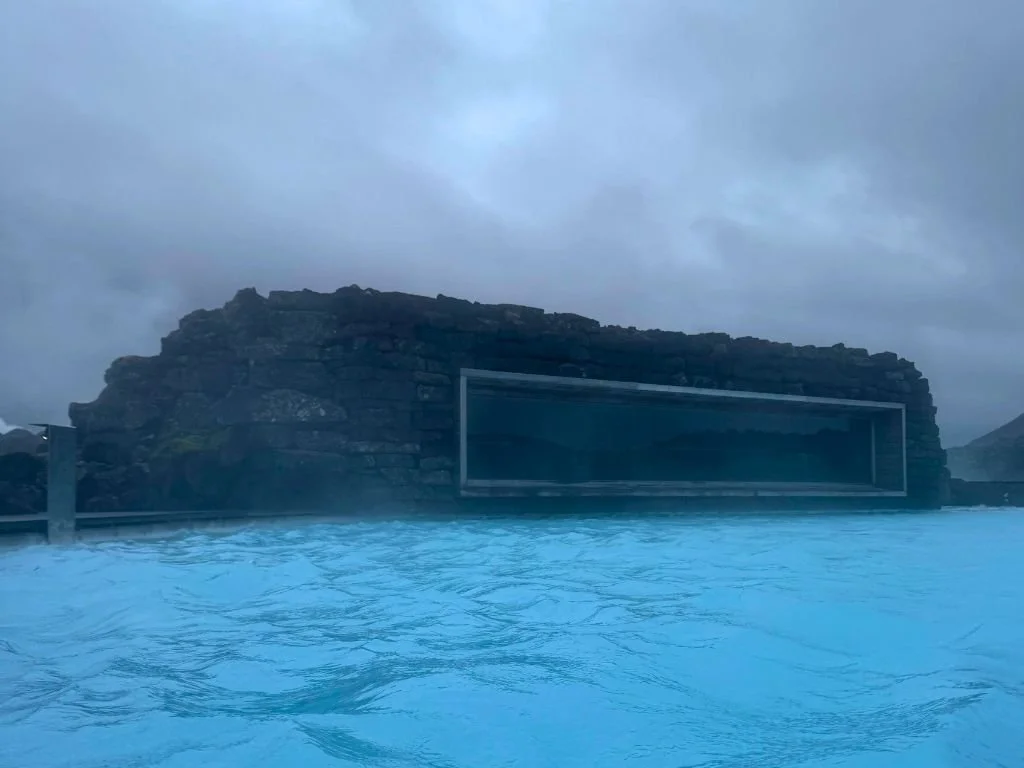
The 38°C water does its work quickly, soaking into jet-lagged bones as steam drifts across the lava fields. We stayed until our fingers pruned to the point of mild concern.
Getting into Reykjavík afterwards was mercifully straightforward. We allowed time to change, retrieved our bags, and caught the Destination Blue Lagoon bus into the city, arriving early afternoon.
The rest of Day 1: Reykjavík
Pro Tip
Reykjavík runs on a series of clearly numbered bus stops. There is more than the major bus companies — Flybus, Reykjavík Excursions, Airport Direct and so on — use the same system. It makes life very easy!
Our bus dropped us at Bus Stop #6 - Safnahúsið, which was less than a 5-minute walk to our hotel. For the record, we stayed at Center Hotels Skjaldbreið. The rooms were tiny, and it was very simple, but the location is amazing.
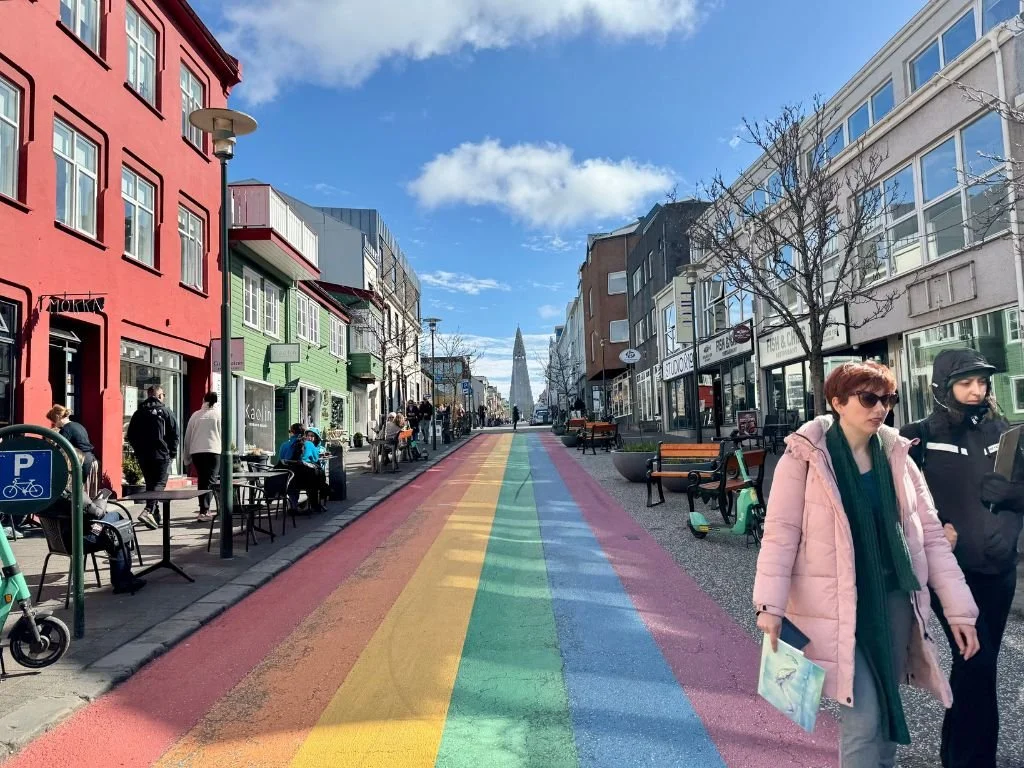
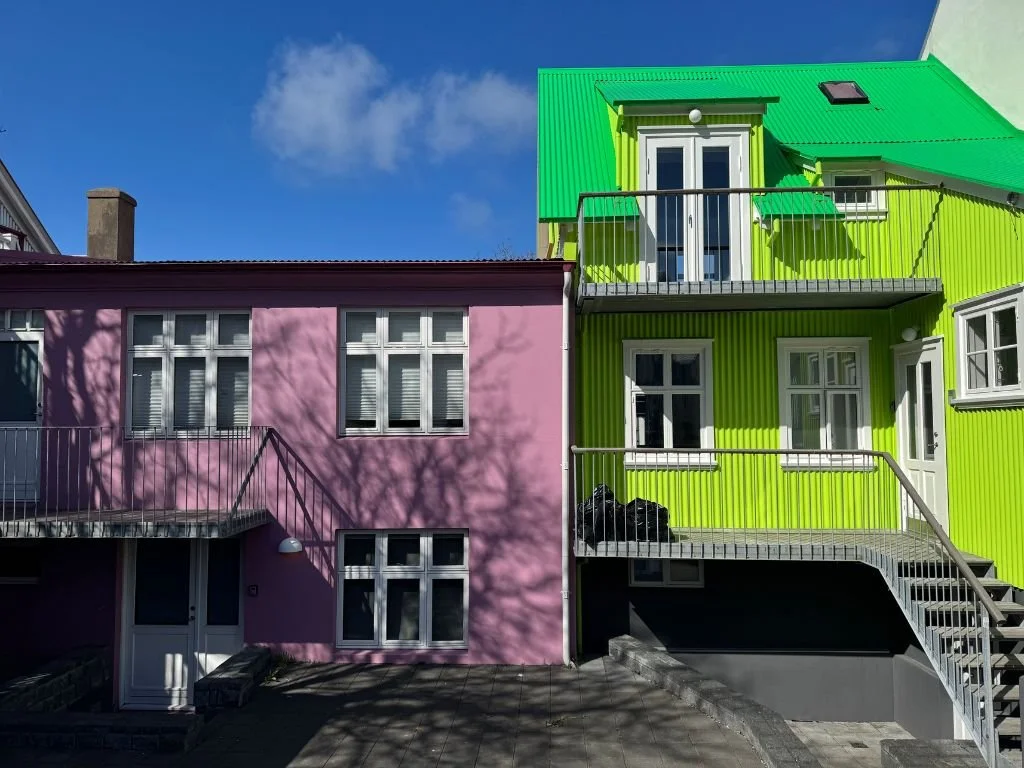
Reykjavík is a very walkable town. It reminded us of a ski village or a fishing town. The brightly coloured houses and buildings are peppered with bakeries, bookshops and bars and familiar chains.
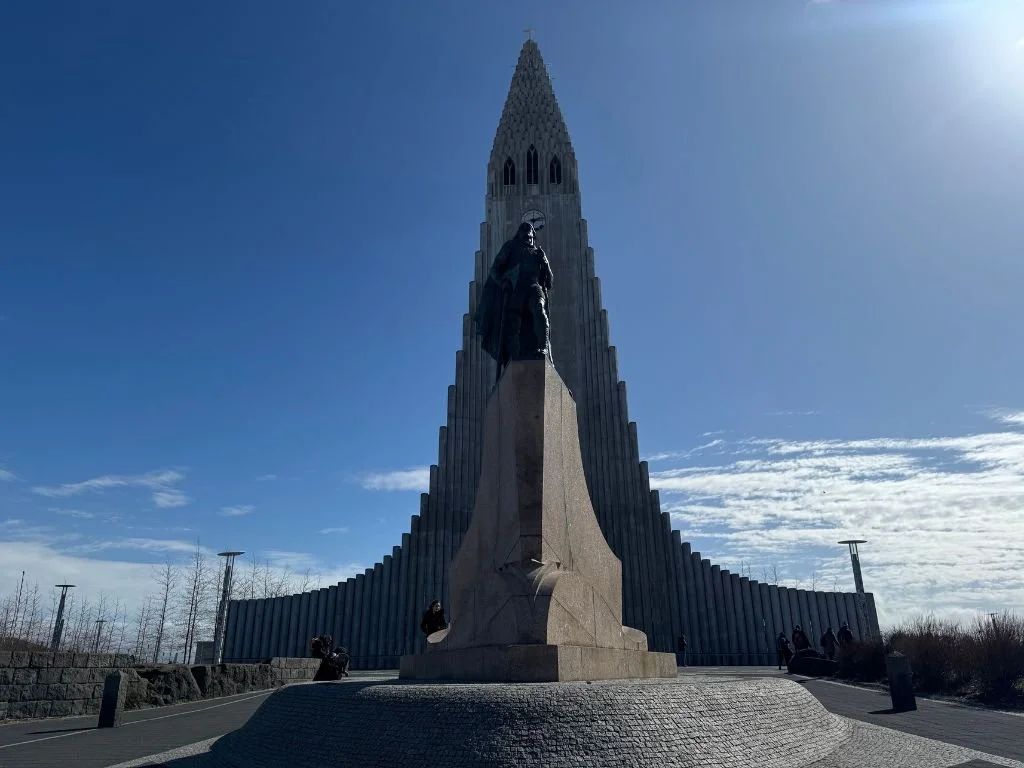
It was a less than 10-minute walk up the Skólavörðustígur Rainbow Street to the iconic Hallgrimskirkja, the prominent church and tower designed by architect Guðjón Samúelsson. The sweeping spire reminds you where you are in the world, and interior is beautiful as well. It’s free to enter, but there is a cost to go up the tower.
The travel fates had bestowed blue skies on us, so it took about the same amount of time to walk down to the waterfront, grabbing some tasty cinnamon scrolls from Brauð & Co on the way. Groups took photos in front of the Sun Voyager monument. All they had to do was look up and see the far more interesting sight: gorgeous mountains dramatically circling the city.
Iceland is notoriously expensive, so we grabbed some supplies from the supermarket before heading out for some drinks. Some of our favourite spots included Hús máls og menningar, a bar that doubles as a bookshop and a live venue; Skuli, which coupled great playlists with an amazing taplist; Uppi, a ‘hidden bar’ across the street from Skuli; and Bingo Bar.

Day 2: The Golden Circle
We had two choices for our final full day: chase the possibility of puffins on Lundey, or take in the Golden Circle and lock in some of Iceland’s most iconic landscapes. It wasn’t a difficult decision.
We booked a full-day Golden Circle tour the night before—something we’d recommend doing earlier if you want your pick of departures. After a 9:00am pickup from Bus Stop #12 Höfðatorg (and the usual slow loop of additional stops), we were on the road. (FYI: this is the one we booked).
Tectonic plates part in Þingvellir (Thingvellir) National Park.
First up was Þingvellir (Thingvellir) National Park, where the North American and Eurasian tectonic plates are quite literally pulling apart. It’s a place of stark beauty—lava rock softened by moss, streams cutting through the landscape—and the historic site of Iceland’s first parliament, dating back to 930 AD. You half expect something mythical to be watching from the rocks.
That moss, we’re told, is protected, and the trees (when they appear) rarely rise above shrub height. There’s a local joke: if you get lost in an Icelandic forest, just stand up.
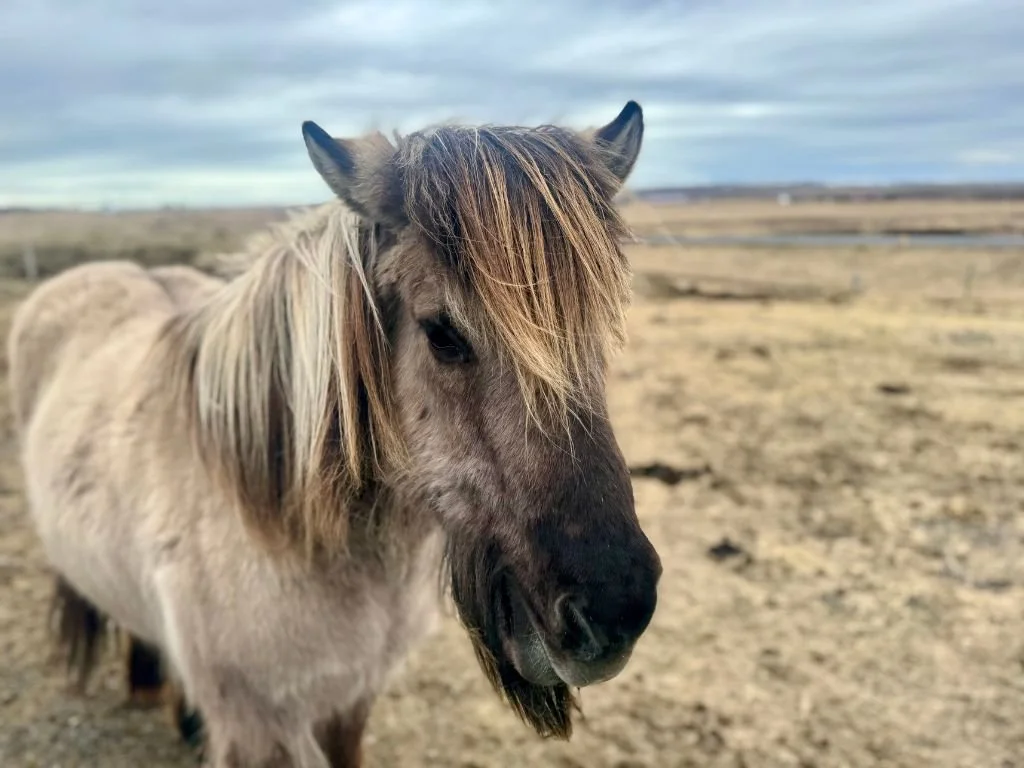
A bonus stop at a horse farm brought us face-to-face with Icelandic horses—smaller, shaggy, and impossibly photogenic. Our guide, accompanied everywhere by a small white dog named Lukka, pointed out the ‘horse candy.’
Then came Gullfoss. At 32m straight down, “Golden Falls” hardly covers it. The scale is difficult to grasp until you’re standing there, the water crashing down in a constant roar that you feel as much as hear. Especially with all the mist kicking up. It’s the kind of place that quietly reminds you how small you are.
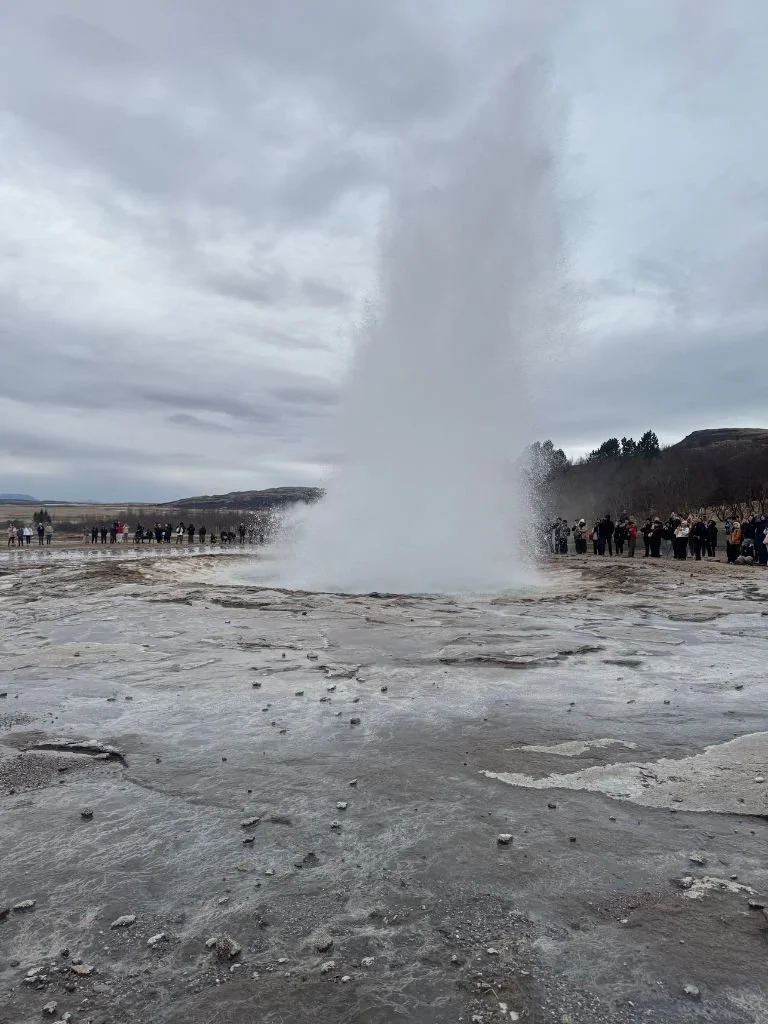
The final major stops were the Geysir geothermal area, where hot water erupts every few minutes with clockwork reliability, and the vividly red-coloured Kerið Crater.
Along the way, it’s the smaller details that stick: geothermal greenhouses glowing against the landscape, rivers repeatedly named Laxá for their salmon, and the occasional piece of art—like Claudio Parmiggiani’s solitary Íslandsvitinn—emerging out of the fog.
Pro Tip
Pack a lunch for the day! While there is a lunch stop at Geysir — and toilets and shops at each of the stops — the food and drinks are consistent with Icelandic pricing. Why not save a few coins by grabbing some bread and fruit from a supermarket like Bonus beforehand?
Getting Back to the Airport
With the high cost of cabs, it’s a good idea to book a FlyBus or similar back to the airport. As we had a boarding before 7:00am, and it takes around 45-50 minutes to get to the airport, we rose at Stupid O’Clock for a 4:00am shuttle pickup.
This is the important bit: our ticket time was 4:30am, so that shuttle was only taking us to the depot. We arrived just before 4:30, boarded the bigger bus and were at Keflavík with time to check our luggage, go through security and find our gate.
The vivid colours of the Kerið (Kerid) Crater is the last stop on the Golden Circle tour.
Quick tips for travellers
- Book the Blue Lagoon early – popular time slots sell out fast, especially mornings and late afternoons.
- Allow extra time at Keflavík International Airport – immigration can be quick…or very much not.
- Don’t cut transfers too fine – buses won’t wait if your flight is delayed.
- Bring swimwear in your carry-on – especially if heading straight to the Blue Lagoon
- Budget for food – eating out in Reykjavík adds up fast.
- Consider a Golden Circle tour vs self-drive – tours are easier; driving gives you flexibility.
- Pack for all weather – conditions change quickly, even within a single day.
Is 48 Hours in Reykjavík enough?
The short answer is no, but it’s enough to get a proper taste.
Reykjavík is an easy city to get around, with most major sights within a 10–15 minute walk of each other. In that sense, two days is surprisingly efficient. We covered most of what we set out to see—puffins notwithstanding.
What becomes clear just as quickly is the cost. Eating out adds up fast, and it’s not hard to see why many visitors stretch their stays with self-driving trips or all-inclusive packages to soften the blow.
Even so, we managed to fit in the Blue Lagoon, explore the city, and take in the Golden Circle within a two-night stay. It’s a packed schedule, but a workable one.
You won’t see everything, but you’ll see enough to feel like you’ve ‘done Iceland’ — or know that you’ll want to come back.