Maps before hotels: Planning your days before your nights

Many of us, when we start planning where to stay, do it backwards.
We add, say, Paris to the itinerary, open Booking.com, find the ones with a private bathroom, and sort by price. We then fall in love with a quaint hotel with the perfect balcony for that imagined Parisian moment, only to realise later that it’s a 45-minute train ride from everything we actually want to do.
The problem isn’t the hotel. The problem is that we don’t yet have a mental map of the city to stop us falling in love with a place in completely the wrong part of town.
When planning for a longer journey, a home base is a critical choice.
In this second part of our series of planning a big trip, we we look at ways to identify that home away from home.
Where do you want to live?
Before choosing where you sleep, decide where you will live your days.
This is especially critical when you’re spending longer times in a location.
Think about the places where you want to spend your precious “in between time”. For us, that usually means a brewery, a locally owned vegetarian café, and an easy train ride to museums. They are almost inevitably clustered together, and these clusters form the real personality of a neighbourhood.
This isn’t about being central to the big hitters of a city, it’s about finding your local respite. A place where you can reset between adventures, rather than just collapse at the end of the day.
How to zoom into your location
It can be tempting to stay in central London or New York to be close to the action, but those areas are increasingly out of reach for many travellers and, quite frankly, not always that enjoyable. Being slightly less central, but close to a great transport line, can save not only your wallet but your sanity. You can see what you want to see and still pop back to your hotel for a recharge (physcial and metaphorical) and maybe an afternoon cuppa.
If you haven’t used Google Maps for trip planning before, we’ve written about it elsewhere, but the high-level approach is simple.
Start with the things you absolutely must do. Ask yourself this question: if I never visit this place again, what would I be heartbroken to have missed? Add those one or two things to your map.
Then move on to the in-between moments. Do you love local crafts? Bookshops? Late-night diners? Do you have dietary needs? Would you rather grab groceries and make simple meals in your room? Add those too. There’s never going to be a “perfect” location, but pinning what matters to you is far more useful than simply being in the centre of everything. Once your map is populated, start looking for the public transport lines that connect most of your pins.
Lessons from the road
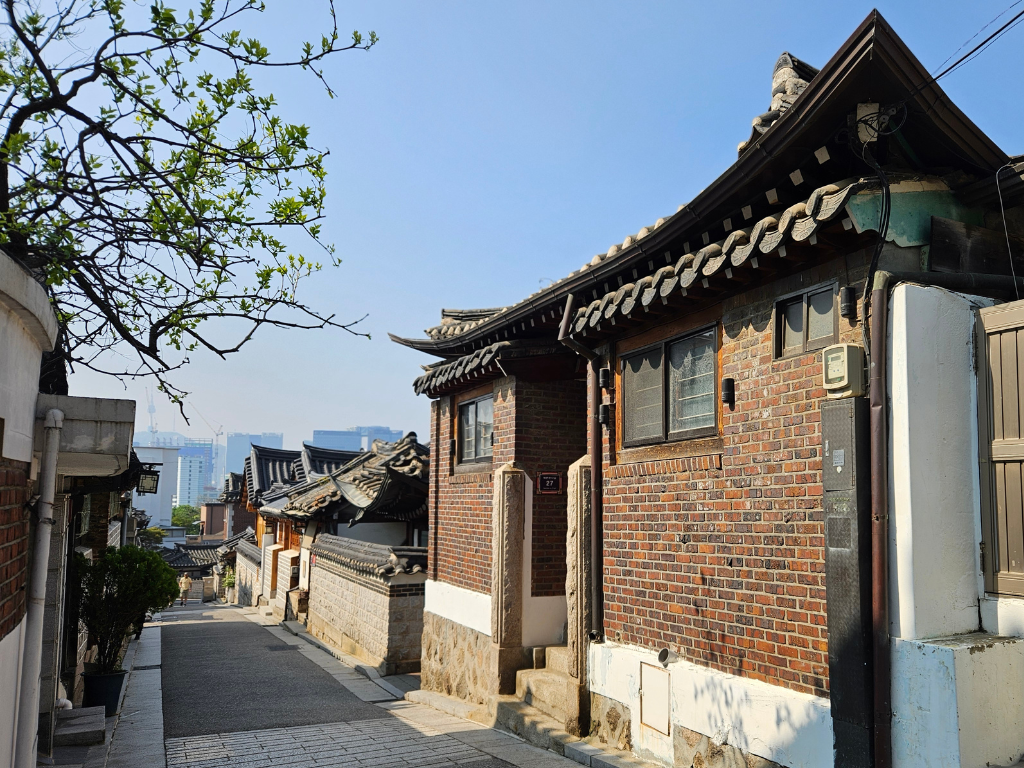
We’ve learned some lessons the hard way. In Amsterdam, we planned to take a lot of day trips and chose a hotel right next to Central Station. The transport access was excellent, but it felt like stepping into an IKEA on a Saturday morning every time we exited the hotel. The crowds were crushing. It was convenient, but exhausting. On the flip side, in Korea we stayed in Insadong, but a few blocks off the main shopping area. It was peaceful, only a five to ten minute walk to a train station, surrounded by vegetarian restaurants we’d already pinned, plus a 24-hour convenience store for late-night snacks. The geography worked with us, not against us.
There are a few common traps to watch out for:
Staying “close to the airport” when you’re only there one night. This can be expensive and, honestly, dull. The exception for us is an early-morning flight, where proximity can be a lifesaver.
Thinking “15 minutes by car” makes sense in cities where you won’t have a car. You’re probably not going to want to Uber everywhere, every day.
Assuming walkability without checking hills, highways, or waterways, especially when arriving with luggage. One useful trick is using Google Maps’ accessibility feature to get a more realistic walking time and avoid surprise staircases.
Having a home base that suits you matters even more when you’re staying somewhere for longer. The right location lets you settle into a rhythm: familiar landmarks to assist in navigation, a favourite café to linger in, a corner shop with that local treat you discovered, a friendly bartender who gets to know your order.
When you choose a location that works with your days, staying longer stops feeling like something you need to optimise and starts feeling natural. You’re not constantly racing back and forth, you’re living in a small, well-chosen pocket of your temporary home.
What’s next?
In our next installment of the series, we’ll look at bookings. When, what order, timing, and other considerations to save you time, energy and maybe even a little money.